
Years 1 to 6
Every child has something worth saying.
Speaking clearly in front of others is one of the most useful skills a child can learn — yet it is a skill that often gets far less practice than it deserves. Some children need help finding the confidence to speak up. Others are already confident and need to be challenged further.
Both belong here, because speaking well is a skill. It can be taught, practised and improved — just like handwriting or times tables.
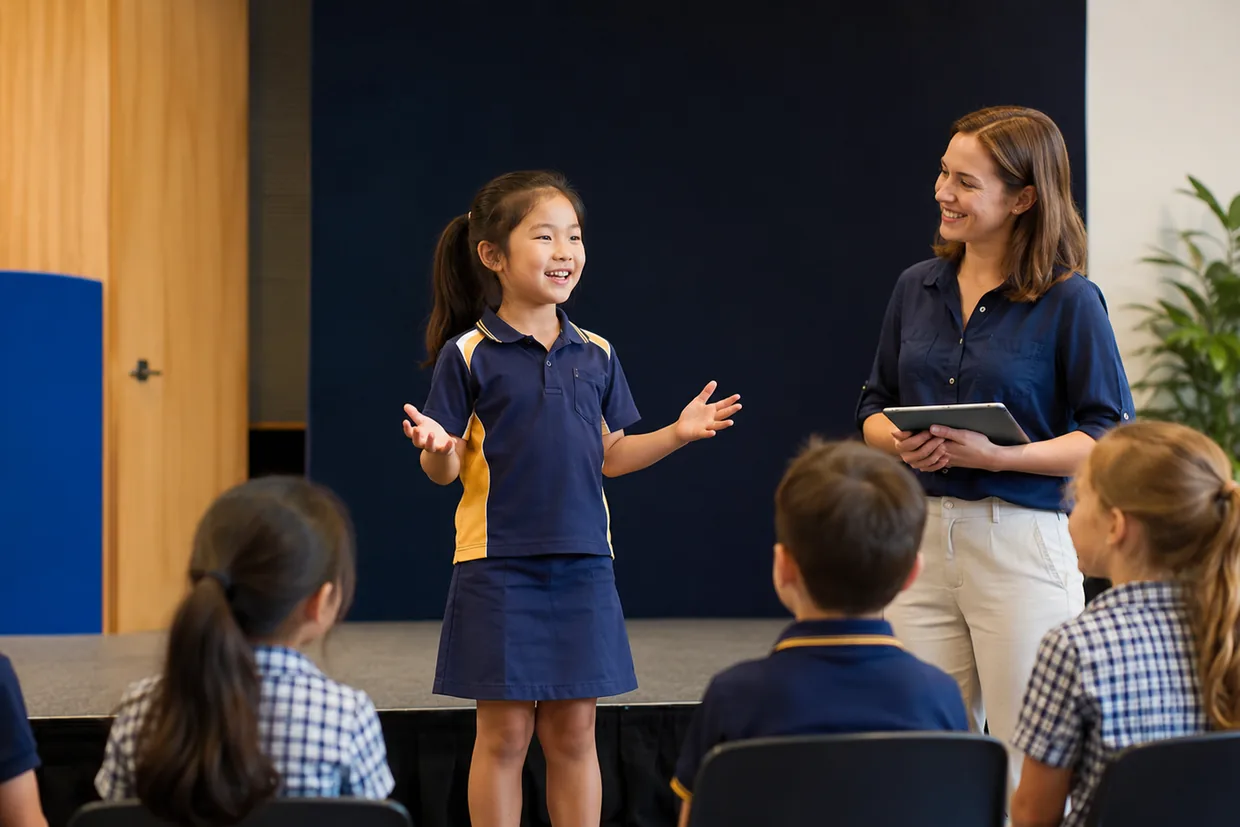
Why this matters
The skill they will use every year of their life.
From news in Year 1 to a job interview twenty years from now, your child will need to explain ideas clearly out loud. Yet speaking is often expected far more than it is explicitly taught.
Children who can speak with confidence, organise their thoughts and hold an audience are more likely to put themselves forward — for the group, the team, the role or the opportunity. And that confidence compounds, year after year.
It is also the skill that decides how much of your child other people ever get to see.
The programme
What your child learns, stage by stage.
Small, specific skills, taught one at a time — never a vague instruction to be more confident.
Years 1–2
Being heard
- Standing still, facing the room
- Volume: loud enough for the back row
- Looking up, not at your shoes
- Saying one idea clearly, from start to finish
Years 3–4
Being understood
- Beginning, middle and end
- Slowing down, and using a pause
- Using your hands on purpose
- Speaking from notes instead of reading
Years 5–6
Being convincing
- One clear message, and sticking to it
- Choosing words for the listener
- Answering a question you did not expect
- Persuading, and handling disagreement politely
Inside a lesson
What a lesson looks like.
Short, active and repetitive in the way that actually builds a habit.
Warm-up
Voice and nerves
Games that get the voice working and take the fear out of the room. Children are laughing before they have noticed they are speaking.
Teaching
One skill at a time
A single, specific skill — how to pause, how to open, where to look. Demonstrated, then practised in pairs.
Speak
In front of the group
Every child speaks. They get one thing they did well and one thing to work on next week. Nothing vague, nothing crushing.
Why here
What makes this different.
Free · no obligation
Ask us about Public Speaking for Kids.
Tell us your child's year and what you are hoping for. We will reply with the next available times.
- 1The right group for your childBy year level and confidence, not just age.
- 2What is coveredThe skills for that stage, in plain language.
- 3When classes runCurrent times, in centre and online.
There is a discount when public speaking is taken alongside another of our courses.
Ask us about our referral discounts.
Straight answers
Questions parents actually ask.
Is this only for shy children?+
No. It is for any child who will one day need to be understood — which is all of them. Quieter children learn to be heard. Confident children, who often plateau because nobody ever corrects them, learn structure, timing and how to handle a question they did not expect. They work on different targets in the same room.
My child is very shy. Will this be too much?+
No child is dragged to the front on day one. They start with a few seconds from their seat and build up over weeks. Shy children often make the biggest change, simply because they have the furthest to travel.
Is this debating?+
No. Debating is competitive and argument-based. This is the groundwork underneath it: being heard, being clear, and being comfortable in front of people. It is excellent preparation if your child later wants to debate.
How will I know my child is improving?+
You will hear it at home first. In class each child gets a specific target each week, so progress is a series of named skills rather than a vague feeling.
Does this help with school and interviews?+
Yes — class presentations, news, group work, leadership roles, and interviews for scholarships or selective placements where speaking is part of the process.